| Year | |
| Event | CERN time travel experiment failure |
| Outcome | Catastrophic event that disrupted space and time • Widespread temporal distortions and anomalies • Global crisis as governments and militaries struggled to respond • Long-term consequences that permanently altered human history |
| Location | |
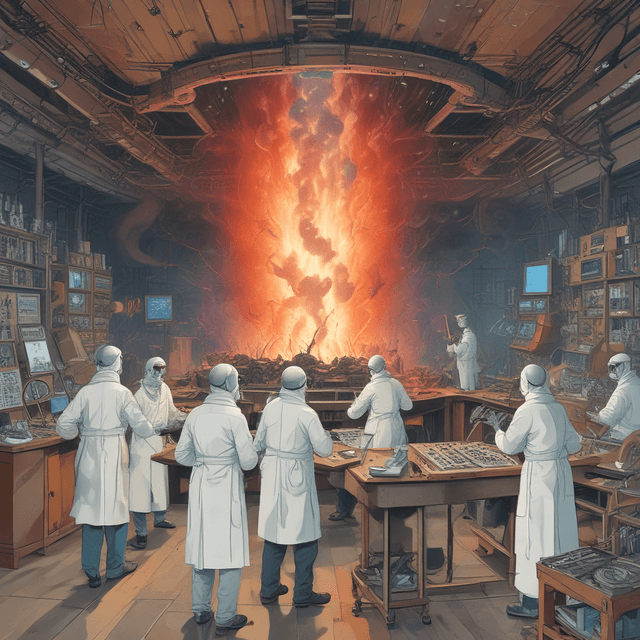
| Description | A failed experiment in time travel at CERN accidentally produced a much larger, unstable black hole that triggered widespread temporal distortions and anomalies, leading to a global crisis. |
In 2028, an experiment at the CERN particle accelerator complex in Geneva, Switzerland led to a catastrophic event that disrupted the normal flow of space-time and had profound long-term consequences for human civilization.
CERN researchers had been working for years on developing technology capable of creating microscopic black holes as a means of enabling time travel. In April 2028, they believed they had perfected the process and conducted a test experiment.
The goal was to generate a tiny, controlled black hole that could be used to open a stable wormhole - a theorized shortcut through the fabric of space-time that would allow for travel to the past or future. However, something went horribly wrong during the experiment.
Instead of the expected micro-black hole, the CERN experiment produced a much larger, unstable singularity. This black hole rapidly grew in size and power, quickly spiraling out of control. The intense gravitational forces tore apart the experimental apparatus and surrounding buildings, causing massive destruction and loss of life on the CERN campus.
But the black hole's effects were not limited to the local area. The immense warping of space-time caused by the uncontrolled singularity began propagating outward, triggering a cascade of temporal anomalies and distortions across a wide region. Normal chronological progression became unpredictable and unreliable.
As the unstable black hole continued to expand, the effects on the flow of time grew increasingly severe. Historical events started occurring out of sequence, with people and objects appearing and disappearing at random. Causality itself seemed to break down in affected areas.
Governments and militaries attempted to respond, but found their efforts hampered by the total disruption of normal space-time. Conventional weapons were ineffective, and even advanced technology malfunctioned unpredictably. Attempts to evacuate or quarantine the affected regions met with limited success as the temporal chaos prevented reliable coordination.
After several weeks of escalating crisis, the international scientific community was ultimately able to devise a method to contain and stabilize the black hole. However, the damage had been done. The 2028 incident had fundamentally altered the fabric of reality, with ripple effects that continue to shape human civilization to this day.
The breakdown of causality and the normal flow of time left an indelible mark. Many historical events were permanently changed or erased. Technological development was disrupted, setting back progress in fields like computing, energy, and transportation. Geopolitical power structures were also transformed, with the rise of new nations and alliances.
Though the immediate disaster was averted, the 2028 Failed Time Travel Incident remains one of the most defining and mysterious events in modern history. Its long-term ramifications are still being grappled with by scholars, scientists, and the general public. The very nature of space, time, and causality has been called into question, leaving humanity to navigate an altered reality.
